Outcome comparison
Where was strength actually measured?
The answer leads to mouse experiments. The most striking human results here concern body weight, glucose and liver fat.
Grip measurements
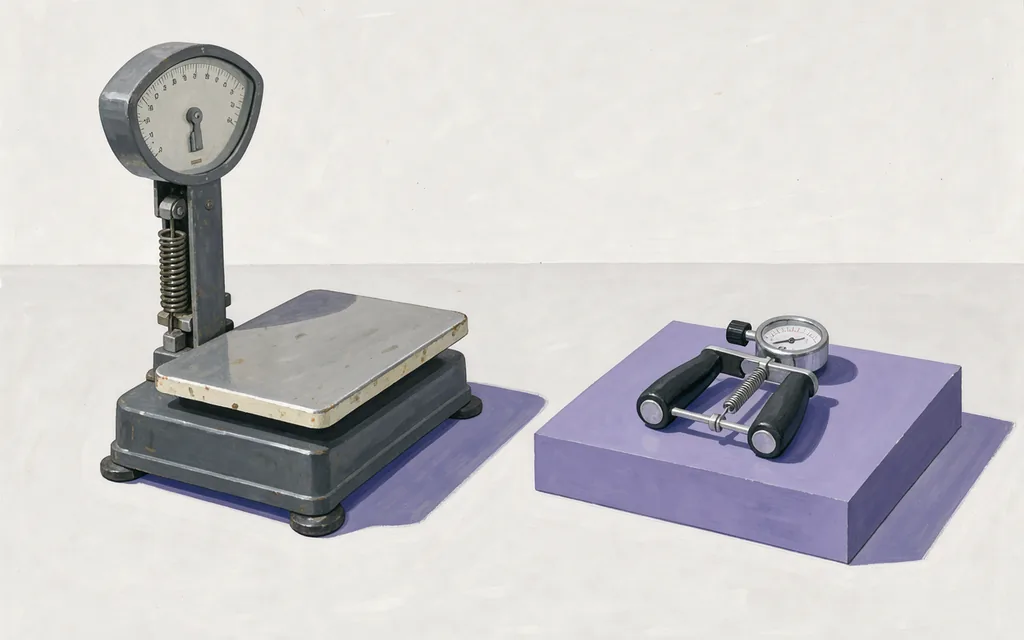
A grip test and a scale answer different physical questions. In MOTS-c-treated mice, researchers measured running capacity, grip strength and gait. In the retatrutide obesity trial, they measured body-weight change and adverse events over 48 weeks. Both can matter. Each result has its own unit, population and time frame.
I would resist combining them into a leaderboard of vitality. An older mouse gripping more firmly makes the muscle work compelling to me. An adult’s weight loss can be important on its own clinical terms. To compare physical function directly would require that outcome to be measured in people.
Measured outcomes
| Research question | Compound and setting | Finding |
|---|---|---|
| Can physical performance change? | MOTS-c, mice of different ages | Improved running capacity, grip strength and gait |
| Can muscle wasting during inactivity be reduced? | MOTS-c, immobilised mice and laboratory assays | Less atrophy, with CK2 identified as a direct target |
| Does fat use change? | AOD-9604, obese mice | Increased fat oxidation and weight loss |
| Does body weight change in people? | Retatrutide, 338 adults | Mean change -24.2% at the highest amount, versus -2.1% with placebo over 48 weeks |
AOD-9604 also reached human obesity trials. Their failure to establish significant weight benefit is essential to its history, alongside the tolerability findings from about 900 participants. Retatrutide has the clearest positive human weight findings of this group, while extra MOTS-c has no established human treatment benefit.
Fuel reaching a muscle
Increased glucose uptake in mouse muscle, a MOTS-c finding, concerns where fuel goes. Increased fat oxidation in AOD-9604-treated mice concerns which fuel gets used. Those findings help explain metabolism without measuring how alert a person feels. I become suspicious when energy quietly changes meaning halfway through an argument.
The retatrutide blood-lipid and metabolite analysis adds evidence about fuel handling in trial participants. Its statistical association with weight change leaves causation and physical performance open. A mechanism may explain a body-weight result while leaving the strength question untouched.
Treatment exposure
The human MOTS-c cohort followed 94 people on haemodialysis for a median of 26.5 months; it measured their existing blood levels. AOD-9604’s human studies followed treatment over 7 days to 24 weeks. Retatrutide’s obesity trial followed treatment for 48 weeks and recorded gastrointestinal effects and a faster pulse. These are different kinds of exposure and follow-up.
My practical conclusion is narrow: there are mouse muscle findings worth pursuing and human weight findings worth taking seriously. None establishes a general vitality treatment. The safety questions include the lack of FDA approval and the uncertain quality of research preparations.