MOTS-c
MOTS-c in a muscle that cannot move
The disuse experiment and the running mice raise separate questions: retaining muscle and improving performance.
CK2 activity
A muscle deprived of movement is a demanding place to test a metabolic idea. In the CK2 study, MOTS-c reduced immobilisation-related muscle wasting in mice and increased muscle glucose uptake. Cell-free experiments showed direct binding to CK2, a protein involved in controlling cellular activity.
The response varied by tissue: CK2 activity rose in muscle and fell in fat. The tissue split makes a blanket claim about switching metabolism on seem especially clumsy to me. The study proposes a specific target and shows that the same target can respond differently around the body. It establishes an animal and laboratory mechanism; a treatment for people losing muscle during inactivity remains to be demonstrated.
The treadmill and the grip test
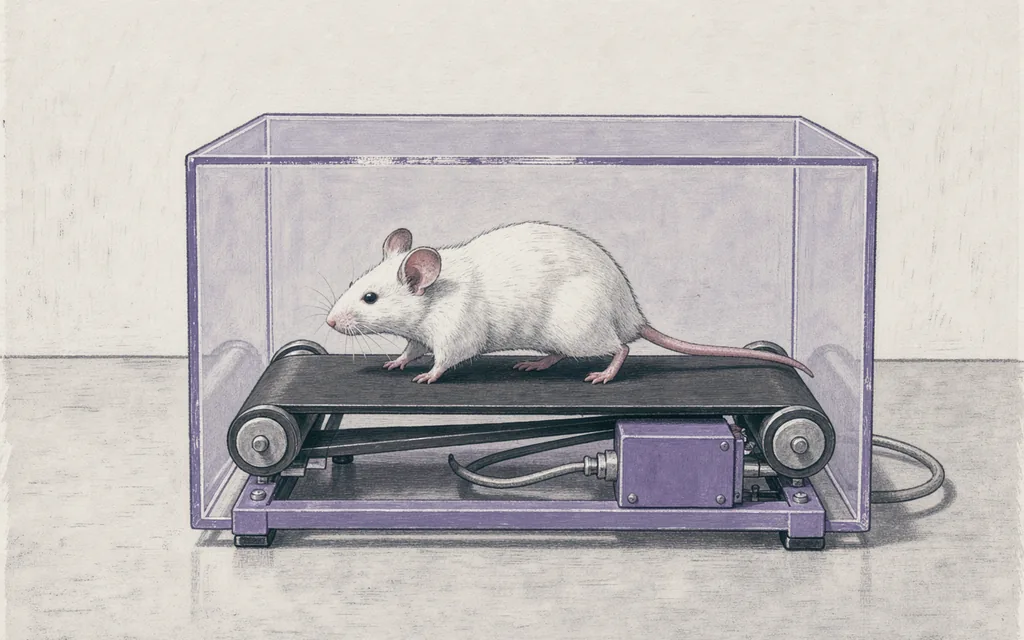
The exercise and ageing study examined young, middle-aged and old mice. Exercise increased their naturally produced MOTS-c. Giving extra improved physical performance, including treadmill running, grip strength and gait; the older mice’s running result was statistically significant.
Running, gripping and walking give this experiment more texture than a single claim about energy. Those endpoints earn my enthusiasm: the animals had tasks to perform. Calling MOTS-c an exercise mimetic means it is being investigated for effects resembling some responses to exercise. The evidence here reaches mice. It leaves human endurance, strength, weight loss and longevity benefits unestablished.
Mitochondria and the nucleus
MOTS-c is encoded in mitochondrial DNA, in the region called 12S rRNA. Mitochondria are the cell structures closely involved in making usable energy from food. The review of MOTS-c biology describes findings from cell experiments on folate metabolism and AMPK, a protein that senses the cell’s fuel supply. Those processes help explain why muscle became such an important experimental target.
In human and mouse cells grown in dishes, nutrient restriction or damage sent MOTS-c into the nucleus, where most of the cell’s genetic instructions are housed. It altered activity around genes involved in stress responses and metabolism. The journey from a mitochondrial origin to the nucleus fascinates me. The experiment measured cell behaviour under stress; it did not measure a person’s alertness.
The people whose blood was measured
The human evidence takes a different form. A cohort of 94 people receiving chronic haemodialysis had naturally circulating MOTS-c measured and was followed for a median of 26.5 months. Higher levels were associated with greater risk of death or non-fatal cardiovascular events, and the measurement modestly improved risk prediction. Nobody was given MOTS-c as treatment.
That setting deserves to stay visible. Severe kidney disease changes the question being asked; a blood association in that population cannot tell us the consequences of giving MOTS-c to someone else. Small studies, differences in ancestry and genetic variants, and mechanisms awaiting independent replication add further uncertainty.
Safety; sport restrictions
There is no established human pharmacokinetic profile here: how extra MOTS-c is absorbed, distributed and cleared, or how effects change with amount. Completed human efficacy trials are absent from this evidence base. That leaves adverse effects and long-term risks poorly characterised. A reassuring human safety list would require evidence missing from the animal work.
MOTS-c lacks FDA approval for human use. Research preparations have uncertain identity, purity and sterility, and elite sport restricts MOTS-c use. The animal findings supply reasons to investigate muscle function further. They supply no validated human injection routine. Approval and handling questions are addressed separately.