Retatrutide
Retatrutide: weight loss and physical function
The human weight results are striking. Physical performance during that change deserves its own investigation. Retatrutide remains investigational.
Weight over 48 weeks
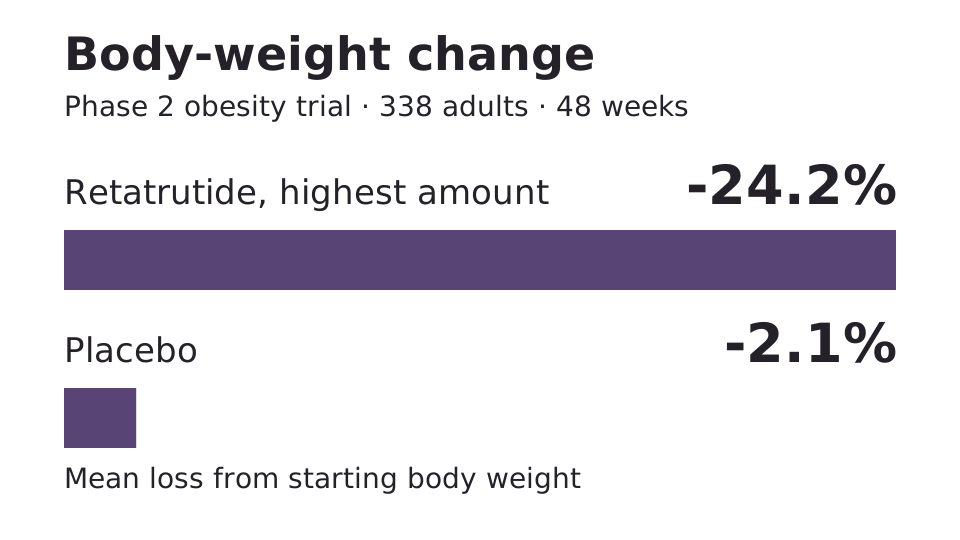
In the phase 2 obesity trial involving 338 adults, mean body-weight change at the highest amount tested was -24.2% over 48 weeks, compared with -2.1% with placebo. Those are changes from starting body weight. For human weight loss, I put this result ahead of the other compounds discussed here.
Larger amounts also brought more gastrointestinal problems, mostly mild or moderate, and more treatment discontinuations. Heart rate rose in a dose-dependent pattern, peaking around week 24. The size of the weight result makes tolerability more consequential: a remarkable average leaves open how many people can remain on treatment and what longer follow-up will show.
Glucose results; liver scans
The phase 2 type 2 diabetes trial enrolled 281 adults. At the highest amount, HbA1c, the blood test reflecting average glucose, changed by -2.02% at week 24 versus -0.01% with placebo. These are changes in the test’s percentage reading. Body weight fell 16.94% at week 36 versus -3.00% with placebo. The trial mainly reported mild or moderate gastrointestinal effects; no severe hypoglycaemia or deaths were reported during it. Rare risks remain unresolved.
The liver substudy involved 98 people with excess weight and fatty liver disease. At the highest amount tested, liver fat fell by 82.4% relative to its starting level at week 24. In that group, 86% reached a liver-fat level below 5% on scans. Those are liver-fat measurements, and they deserve their own attention alongside body weight. They leave broader health outcomes to further study.
Receptors and clearance
Retatrutide, also called LY3437943, activates receptors for GIP, GLP-1 and glucagon. The first two hormone systems affect eating and glucose-dependent insulin release; glucagon adds actions on fuel use and stored fat. Structural and cell-based experiments confirmed engagement of the three receptors.
A fatty attachment helps the molecule bind a blood protein and remain in circulation. In phase 1b testing in 72 adults with type 2 diabetes, its half-life was about 6 days. Over 12 weeks, the highest-amount group had a placebo-adjusted weight change of -8.96 kilograms. These are findings from a supervised trial, with no validated instructions here for material obtained outside it.
A later analysis of blood lipids and metabolites from two phase 2 trials linked changes in a fat-oxidation cluster to 23.2% of the weight-reduction response in participants without type 2 diabetes. This was a post-hoc statistical analysis. It cannot establish that those blood changes caused that share of weight loss, or convert it into a measure of muscle performance.
Function; fatigue
I think physical improvement needs a wider description than the change on a scale. The weight, glucose and liver results establish changes in those outcomes; the strength and endurance questions need direct measurements of function. The review of retatrutide’s early clinical programme also leaves long-term cardiovascular, kidney and post-treatment outcomes unsettled.
Community accounts add another, much weaker layer: reduced hunger and intrusive thoughts about food, nausea, belching, constipation, warmth, fatigue, a faster resting pulse, local irritation, and occasional changes in sleep or mood. Some describe softer-feeling muscles during rapid weight loss. All of these accounts are anecdotal and lack verified contents or clinical oversight; they cannot establish causes or frequencies. Warmth alone cannot persuade me that useful energy has increased.
Retatrutide lacks FDA approval and remains in phase 3 testing. A preparation outside a trial has unconfirmed identity, strength, impurities and sterility. The clinical findings warrant serious interest, while personal treatment decisions and the question of lasting physical benefit remain outside what these pages can settle.